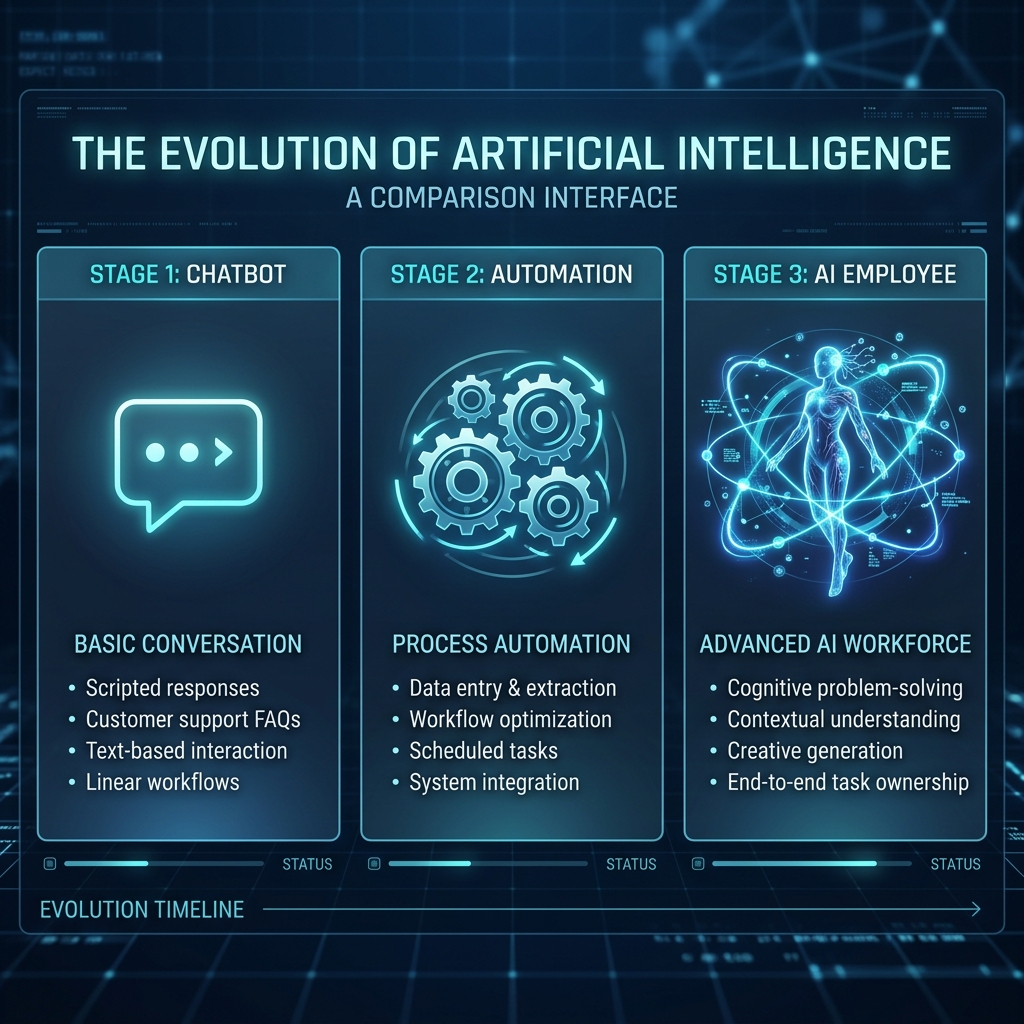
A chatbot answers questions. RPA repeats a fixed sequence. An AI employee owns an outcome — it adapts its steps, uses judgement, and finishes the job. They sound similar, but choosing the wrong one wastes months and budget.
If you're evaluating ways to automate work in 2026, you'll hear all three terms used interchangeably by vendors who should know better. Here's the honest breakdown.
The one-line definitions
- Chatbot: a conversational interface that answers questions from a script or knowledge base.
- RPA / automation: software that repeats a pre-recorded sequence of clicks and rules.
- AI employee: an autonomous AI worker that completes multi-step business tasks end-to-end, adapting as it goes.
Side by side
| Capability | Chatbot | RPA / Automation | AI Employee |
|---|---|---|---|
| Handles open-ended language | Limited | No | Yes |
| Completes multi-step tasks | No | Fixed path only | Yes, adaptively |
| Uses real tools & data | Rarely | Yes, rigidly | Yes, flexibly |
| Adapts when things change | No | Breaks | Yes |
| Works 24/7 unsupervised | Partly | Yes | Yes |
| Best for | FAQs | Repetitive rule-based steps | Owning a role/outcome |
RPA automates a task. An AI employee takes responsibility for a job.
When should you use each?
Use a chatbot when…
Your customers ask the same handful of questions and you just need fast, accurate answers. A chatbot is a front door, not a worker.
Use RPA when…
You have a high-volume, perfectly repetitive process that never changes — moving data between two systems in a fixed format, for example. RPA is cheap and reliable until the screen layout changes.
Use an AI employee when…
The work requires judgement, varies case to case, or spans multiple tools. Reading a contract and flagging risks, qualifying a lead, resolving a support ticket in Hinglish at 3 AM — these need an AI employee, not a script.
Why AI employees are the evolution, not a replacement
You don't throw away your chatbot or your automations. An AI employee sits above them — it can trigger an RPA flow, hand off to a chatbot, or escalate to a human. It's the layer that holds the role together. New to the concept? Start with What Is an AI Employee?
The bottom line
If you need an answer, build a chatbot. If you need a repeated action, use automation. If you need a job done — reliably, around the clock, with judgement — hire an AI employee. Tell us what you're trying to automate and we'll point you to the right tool, even if it isn't us.